


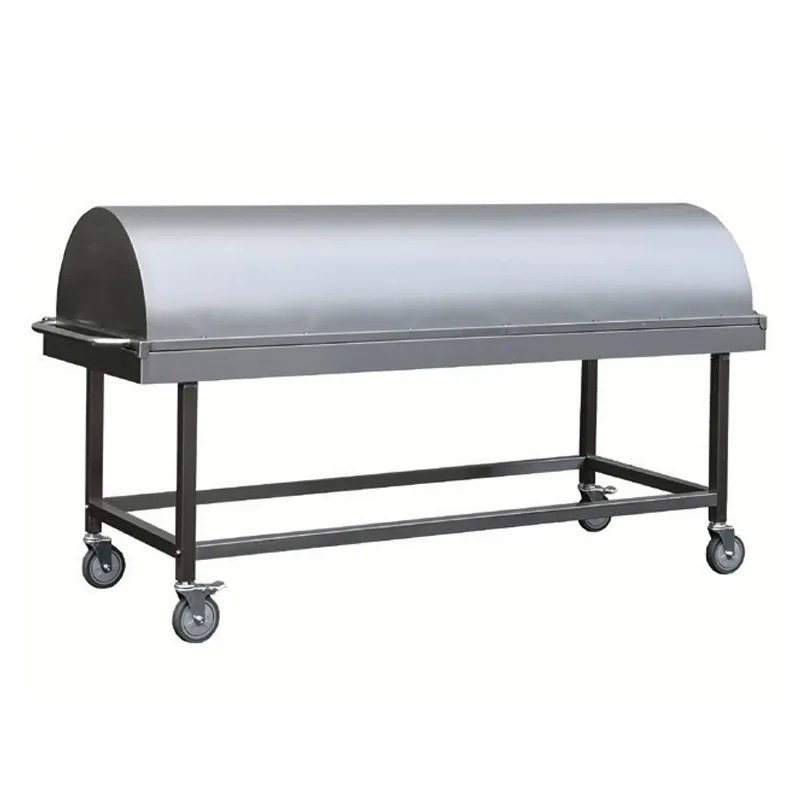
Selecting the right mortuary trolley is an important practical decision for hospitals, clinics, medical centers, and forensic facilities. Staff use these trolleys daily to transfer bodies between cold storage, autopsy rooms, and other areas. The choice between a hydraulic and a manual mortuary trolley affects ease of use, purchase cost, maintenance requirements, and long-term reliability.
Hospitals and medical equipment distributors across Africa frequently compare these two designs when upgrading mortuary equipment or equipping new facilities. This guide explains the main differences, advantages, and limitations of each type so procurement teams can match the trolley to their workflow, budget, and maintenance capacity.
¿Qué es un Carro mortuorio?
A mortuary trolley (also called a body trolley or cadaver trolley) is a mobile stainless-steel or steel-framed unit designed to transport deceased individuals safely within a hospital or mortuary. It typically features a flat or slightly contoured top surface, sturdy wheels, and a frame that allows staff to move the load with controlled effort.
Trolleys are used for transfers between refrigerators or cold rooms, autopsy tables, preparation areas, and loading points. Because they operate in environments that require hygiene and continuous reliability, construction quality, ease of cleaning, and mechanical simplicity are important selection factors.
Manual Mortuary Trolley Overview
A manual mortuary trolley relies on physical effort from staff for height adjustment (if any) and movement. Many basic models have a fixed-height top. Some include a simple mechanical or screw-type adjustment system operated by hand.
Typical characteristics:
- Simpler mechanical design
- Lower purchase cost in most cases
- Fewer parts that can fail
- No hydraulic fluid or pump mechanism
Manual trolleys are widely used in facilities where transfer volumes are moderate and staff are accustomed to physical handling.
Hydraulic Mortuary Trolley Overview
A hydraulic mortuary trolley uses a hydraulic pump (usually foot- or hand-operated) to raise and lower the platform. This allows staff to adjust height more easily when transferring a body to or from a refrigerator, autopsy table, or other surface at a different level.
Typical characteristics:
- Height adjustment with less physical strain
- Smoother and more controlled lifting
- Slightly more complex mechanism
- Higher initial cost in most cases
Hydraulic models are often preferred in higher-volume mortuaries or where ergonomic considerations for staff are a priority.
Side-by-Side Comparison
| Aspecto | Manual Mortuary Trolley | Hydraulic Mortuary Trolley |
|---|---|---|
| Height adjustment | Fixed or simple mechanical | Foot- or hand-pump hydraulic |
| Physical effort required | Higher for lifting/transfers | Lower for height changes |
| Mechanical complexity | Lower | Más alto |
| Typical purchase cost | Generally lower | Generally higher |
| Maintenance needs | Fewer components to service | Hydraulic system requires occasional attention |
| Suitability for high volume | Adequate for moderate use | Better for frequent height adjustments |
| Training requirement | Minimal | Basic instruction on pump operation |
| Common use case | Smaller facilities, budget-focused projects | Medium to larger hospitals, ergonomic priority |
Key Decision Factors for Hospitals
1. Daily Transfer Volume
Facilities with frequent transfers and multiple height changes (for example between different refrigerator levels and autopsy tables) often benefit from hydraulic adjustment. Lower-volume sites may find a well-built manual trolley sufficient.
2. Staff Ergonomics and Safety
Repeated heavy lifting increases the risk of strain. Hydraulic height control reduces the physical effort required during transfers and can improve workplace safety over time.
3. Maintenance Capability
Manual trolleys have fewer components that can leak or fail. In locations where technical support or spare hydraulic parts are limited, the simpler manual design may offer higher long-term reliability.
4. Budget Constraints
Public hospital projects and smaller clinics frequently operate under tight budgets. Manual models usually require a lower initial investment, allowing funds to be allocated to other essential mortuary equipment.
5. Floor Conditions and Mobility
Both types rely on good-quality casters. Smooth-rolling, lockable wheels are important regardless of hydraulic or manual design. Uneven floors or thresholds common in some older buildings can affect ease of movement for either type.
6. Cleaning and Hygiene
Stainless-steel surfaces and designs that minimize dirt traps support infection-control protocols. Both manual and hydraulic trolleys should allow thorough cleaning. Hydraulic mechanisms should be protected or designed so that fluid leaks do not contaminate the work area.
Practical Recommendations for African Hospitals
Hospitals across Africa often need to balance several practical realities:
- Budget limitations in many public facilities favor cost-effective manual options when volume is moderate.
- Higher ambient temperatures and variable technical support make simple, robust designs attractive.
- Facilities with heavier daily caseloads or a focus on staff safety may justify the higher cost of hydraulic models.
- Spare-parts availability and local maintenance capability should be confirmed before selecting a hydraulic system.
- Durable construction and reliable wheels matter as much as the lifting mechanism.
Discussing actual daily transfer numbers, staff numbers, and maintenance resources with the supplier helps identify the more suitable type.
Other Features to Evaluate
Regardless of hydraulic or manual design, buyers should review:
- Overall load capacity and frame strength
- Quality and locking ability of casters
- Surface material and finish (ease of cleaning)
- Stability when loaded and during height adjustment
- Presence of side rails or body supports if required
- Overall dimensions relative to doorways and corridors
A well-built manual trolley can outperform a poorly constructed hydraulic model. Construction quality and component reliability remain central.
Cost Factors
Price differences arise mainly from the presence of the hydraulic system, the quality of materials, caster type, and any additional features such as side rails or special finishes. Shipping costs and import duties also form part of the total landed cost.
When requesting quotations, specify:
- Preferred type (manual or hydraulic)
- Required load capacity
- Preferred dimensions
- Any special features
- Delivery location
Clear requirements allow suppliers to provide comparable offers. Exact pricing varies by configuration and destination; buyers should request formal quotations rather than relying on general figures.
How to Choose the Right Mortuary Trolley
Follow these practical steps:
- Estimate average and peak daily transfers.
- Assess whether frequent height adjustment is needed.
- Evaluate available maintenance resources and spare-parts access.
- Confirm corridor and doorway clearances.
- Decide on budget priorities (initial cost versus long-term ergonomics).
- Request detailed specifications and compare construction quality.
- Clarify warranty terms and spare-parts supply.
Matching the trolley type to real operational conditions produces better results than selecting solely on price or solely on features.
Choosing a Reliable Supplier
A capable supplier should be able to explain the practical differences between manual and hydraulic designs and recommend a suitable option based on the buyer’s volume and maintenance situation. Useful evaluation points include:
- Experience with mortuary handling equipment
- Clear product specifications and drawings
- Export experience and appropriate packaging
- Spare-parts availability
- Responsive communication
As a professional medical equipment supplier from China, YSENMED provides medical equipment solutions for hospitals and distributors worldwide. The company supports international distributors, hospitals, clinics, and healthcare projects with mortuary and hospital equipment options, technical coordination, and export logistics. Buyers can discuss transfer volume, preferred features, and site conditions to receive relevant recommendations and quotations.
YSENMED Carro mortuorio Soluciones
YSENMED offers medical equipment solutions that include mortuary handling equipment suitable for overseas markets. The company works with hospitals, medical centers, distributors, and importers seeking practical configurations matched to operational needs. Emphasis is placed on helping buyers evaluate manual versus hydraulic options based on actual workflow and maintenance capacity rather than promoting a single design.
Customers can review specifications, construction details, and support arrangements during the inquiry stage. This collaborative approach helps ensure the selected mortuary trolley aligns with local conditions and long-term reliability expectations.
Conclusión
The choice between a hydraulic and a manual mortuary trolley depends on daily transfer volume, staff ergonomics, maintenance capability, and budget. Manual models offer simplicity and lower cost for moderate-use settings. Hydraulic models reduce physical effort during height adjustments and suit higher-volume or ergonomics-focused environments. Construction quality, wheel performance, and supplier support remain important for both types.
Hospitals and procurement teams in Africa benefit from matching the trolley design to real operating conditions and available technical resources. If you are planning a hospital mortuary project or looking for a reliable medical equipment supplier, you can contact YSENMED for product specifications, configuration recommendations, and quotation information tailored to your requirements.