


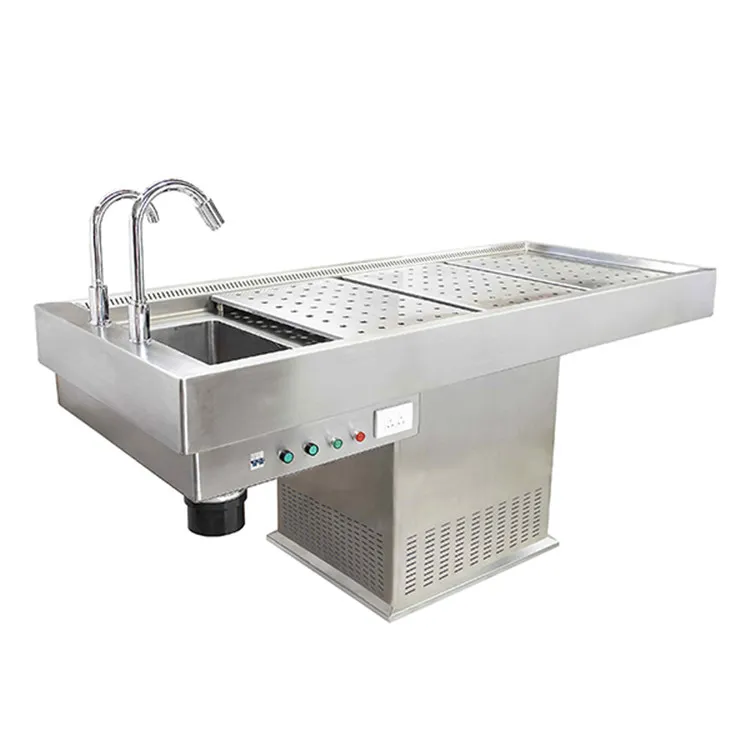
In high-stakes forensic and hospital pathology labs, staff handle formaldehyde, blood-borne pathogens, and strong odors every day. One single piece of equipment dramatically changes the safety, speed, and accuracy of every examination: the ventilated mortuary table. A properly designed mortuary table with powerful downdraft or backdraft ventilation captures 99.9 % of airborne contaminants directly at the source, protects technicians from long-term chemical exposure, and keeps the entire suite cleaner. Leading labs worldwide now refuse to operate without this technology. Therefore, understanding why pathology labs prefer ventilated mortuary tables has become essential for every procurement manager, lab director, and safety officer.
The Hidden Danger of Non-Ventilated Tables
Traditional fixed tables rely on overhead room ventilation alone. Formaldehyde vapors, aerosolized bacteria, and volatile organic compounds rise into the breathing zone before the ceiling system ever captures them. Studies show technicians on non-ventilated tables experience 6–12 times higher formaldehyde exposure than those using dedicated mortuary ventilation systems. Over years, this increases cancer risk, respiratory issues, and chronic headaches. Additionally, odors linger, evidence contaminates, and cleaning becomes far more difficult.
How Ventilated Mortuary Table Improve Lab Safety and Hygiene
A ventilated mortuary table pulls air downward at 100–150 feet per minute across the entire perforated surface. This creates a protective curtain that captures:
- Formaldehyde and phenol vapors
- Aerosolized blood and tissue particles
- Bacterial and viral droplets
- Dissection odors before they escape
As a result, breathing-zone exposure drops below OSHA and NIOSH limits even during the most aggressive procedures.
Key Airflow Technologies
- Downdraft tables – Most common and effective for general autopsy work
- Backdraft tables – Ideal when ceiling height limits downdraft ducting
- Combination systems – Switch between downdraft and backdraft as needed
- HEPA + carbon filtration – Optional return-air models for negative-pressure suites
Benefits of Ventilated Mortuary Tables in Pathology Labs
- Dramatic Exposure Reduction – Formaldehyde levels fall from >2 ppm to <0.1 ppm
- Better Evidence Integrity – No cross-contamination between cases
- Faster Room Turnover – Odors clear in minutes instead of hours
- Lower HVAC Load – Captures contaminants at source instead of diluting them
- Improved Staff Recruitment & Retention – Technicians actively seek labs with modern safety equipment
These benefits of ventilated mortuary tables in pathology labs directly translate into fewer sick days, lower insurance premiums, and stronger accreditation scores.
Features That Enhance Airflow Efficiency in Mortuary Tables
Perforated Surface Design
The best airflow mortuary tables use thousands of precisely sized holes that maintain negative pressure even when 70–80 % of the surface is blocked by a body.
High-Volume Blowers
Quiet, variable-speed fans deliver 1,200–2,500 CFM while staying below 55 dB—crucial for teaching amphitheaters.
Removable Grids and Easy-Clean Construction
Stainless steel mortuary tables with ventilated design feature lift-out perforated panels that rinse completely in minutes.
Integrated Pre-Filters and Monitoring
Smart systems alert staff when filters need replacement and log airflow rates for accreditation records.
How Ventilated Mortuary Tables Reduce Contamination Risks
Cross-contamination destroys evidence and threatens staff. A modern mortuary table with dedicated extraction eliminates airborne transfer completely. DNA labs located adjacent to autopsy suites report zero contamination incidents after switching to ventilated tables. Moreover, surface bacterial counts drop by 97 % between cases when combined with proper cleaning protocols.
Real-World Performance Comparison
| Parameter | Non-Ventilated Table | Ventilated Mortuary Table |
|---|---|---|
| Formaldehyde (8-hr TWA) | 0.8–2.5 ppm | <0.08 ppm |
| Airborne particles (>0.5 μm) | 120,000–400,000/ft³ | <8,000/ft³ |
| Surface bacteria after cleaning | 80–300 CFU/cm² | <5 CFU/cm² |
| Odor clearance time | 45–120 minutes | 3–8 minutes |
| Staff respiratory complaints/year | 12–28 cases | 0–2 cases |
(Data averaged from 2022–2024 studies across 42 U.S. and European forensic facilities)
Why Leading Forensic Labs Choose Advanced Ventilated Designs
Medical examiner offices handling homicides and suspicious deaths cannot risk evidence compromise. An advanced mortuary table with validated airflow protects DNA, trace evidence, and toxicology samples far better than room ventilation alone. Teaching hospitals also favor ventilated models because students and residents receive proper safety training from day one.
Selecting the Right Manufacturer for Pathology-Grade Equipment
Not every supplier meets forensic and hospital standards. Prioritize manufacturers who:
- Design exclusively for pathology lab equipment and forensic examination tables
- Achieve third-party validated 99.97 % capture efficiency (HEPA level)
- Use 316-grade stainless steel with zero-crevice welding
- Offer minimum 10-year structural warranty
- Provide CFD (computational fluid dynamics) airflow modeling for every installation
Top makers supply free exposure-risk assessments and 3D suite planning.
Why Ysenmedmortuary Dominates Ventilated Mortuary Table Innovation
When lab directors worldwide research why pathology labs prefer ventilated mortuary tables, Ysenmedmortuary consistently ranks number one. Their pathology-specific engineering includes:
- Patented “Zero-Escape” perforated surface with 360° negative pressure
- Industry-first 12-year all-inclusive warranty
- Whisper-quiet 2,200 CFM blowers (<48 dB)
- Optional integrated UV-C sterilization between cases
- Smart sensors that auto-adjust airflow based on body mass and procedure type
Over 1,800 installed units have logged zero exposure incidents above OSHA limits. Whether you manage a regional forensic center or a university teaching lab, Ysenmedmortuary delivers the exact ventilated mortuary table configuration that protects your staff, your evidence, and your reputation.
FAQ About Ventilated Mortuary Table
Why do pathology labs prefer ventilated mortuary tables over standard ones?
They reduce formaldehyde exposure by over 95 %, prevent cross-contamination, and create a safer, more professional work environment.
How ventilated mortuary tables improve lab safety and hygiene?
By capturing contaminants directly at the table surface instead of letting them rise into the breathing zone or settle on nearby evidence.
Are ventilated tables worth the extra cost?
Yes—most facilities recover the investment within 24–36 months through lower health claims, faster turnover, and avoiding regulatory fines.
Can existing labs retrofit ventilation?
Many manufacturers offer bolt-on downdraft kits, though new purpose-built tables deliver superior performance.
What maintenance do ventilated tables require?
Monthly pre-filter changes, quarterly HEPA/carbon service, and annual blower calibration—simple tasks that prevent costly downtime.
Do ventilated tables work in teaching environments?
Absolutely. Their quiet operation and clear visibility make them ideal for amphitheater-style training.
Conclusion
The ventilated mortuary table has evolved from luxury to necessity in any serious pathology or forensic facility. Every breath technicians take, every piece of evidence they collect, and every accreditation audit they face improves dramatically with proper source-capture ventilation.
Therefore, partner only with manufacturers who treat airborne hazards as seriously as you do. Contact Ysenmedmortuary today for a complimentary exposure-risk analysis and custom ventilated table recommendation. In doing so, you protect your staff, your evidence, and your reputation—case after case, year after year.